
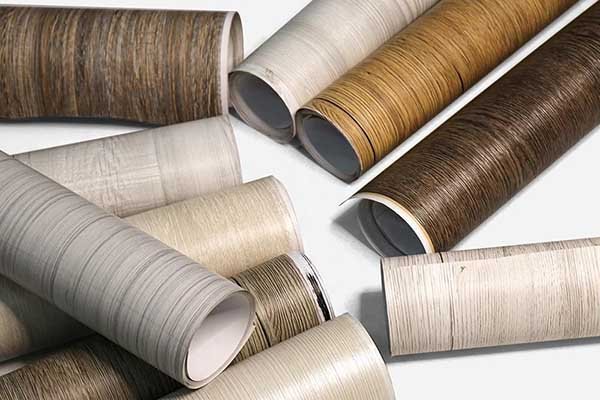
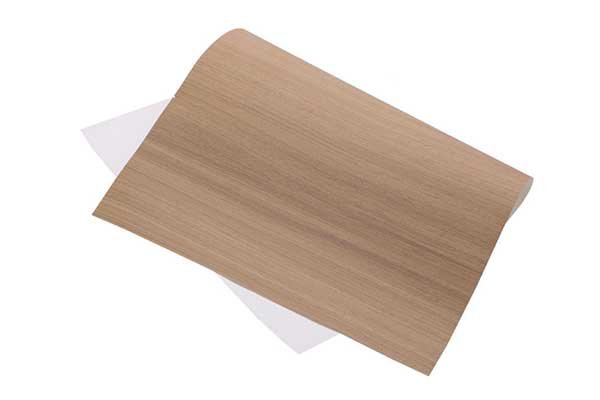
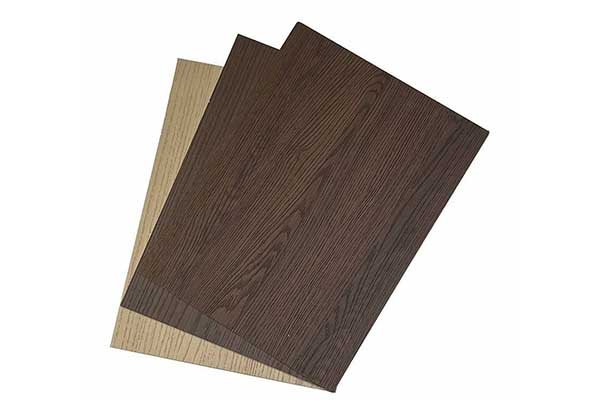
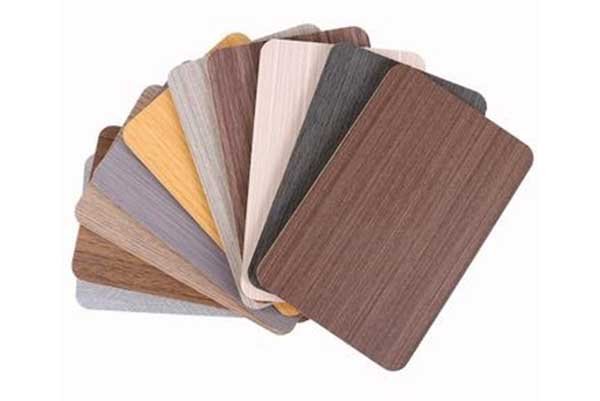
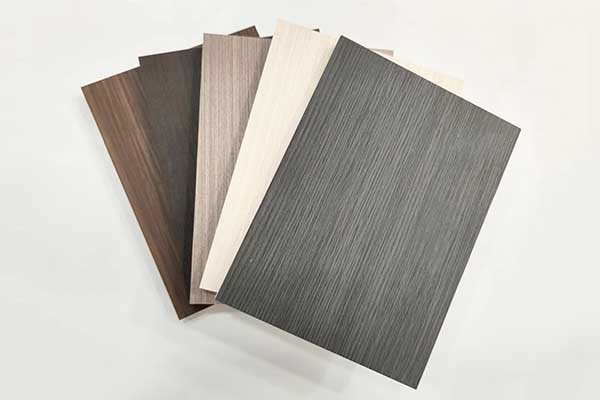
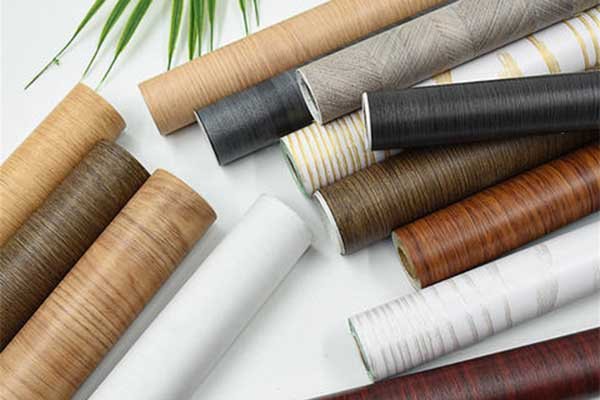


Veneer looks superb and behaves badly. It moves with humidity, it varies between sheets from the same log, it needs finishing, and in a bathroom or a kitchen it will eventually let water in somewhere. Wood grain PETG film gives a panel the same visual language with none of that: a printed and embossed decorative surface that is waterproof, dimensionally stable, and identical on the thousandth panel and the first. Goflexpet produces it on its own extrusion, printing and embossing lines in Ganzhou, China.
Three steps make the difference between a convincing panel and a plastic imitation. The decor is printed from a scan of real timber, so the pattern includes the irregularities a repeated artificial grain lacks. The surface is then embossed, and on our synchronized grades the emboss registers to the print, meaning the texture you feel sits exactly on the grain line you see. Finally a topcoat sets the sheen level, from a low matte through to a satin. Register accuracy is what separates a premium wood effect plastic sheet from a cheap one, and it is worth asking any supplier whether their emboss is synchronized or random.
Most decorative foil in this market has historically been PVC. PETG does the same job without chlorine or the plasticizers that migrate out of PVC over time, which matters for buyers selling into markets with restrictions on PVC in interiors, and for anyone whose customers ask about material content. Glycol-modified polyester is also tougher on the edge — it wraps a profile without whitening at the fold — and it holds color longer under interior light. A PETG wood surface will not turn yellow or brittle the way an unstabilized foil can.
Rigid plastic wood sheets are cut to length for panel presses and fabrication, while roll stock feeds continuous lamination and profile wrapping lines.
Cabinet doors and carcasses, wardrobe fronts, wall panelling, ceiling panels, door skins, shopfitting and office furniture all use this material, usually laminated onto MDF, particleboard or plywood. Profile wrapping is the other major use: because the film follows a shaped edge, a wooden plastic sheet finish can run continuously across a face and around its profile without a visible break. In wet areas — bathrooms, laundries, commercial kitchens — the waterproof surface is the reason it is chosen over veneer at all. It is also the reason specifiers use it in rental and hospitality projects, where panels have to survive tenants and cleaning crews rather than careful owners.
Most inquiries start with a physical sample rather than a code, and that is the right way to do it. Send us the panel, foil or timber sample you are matching and we will reproduce the decor, including the PETG wood color tone and the grain scale. Once a wood PETG decor is approved it becomes a fixed reference, and every later batch is checked against the signed sample rather than against a print file. Custom decors need a printing cylinder, so they carry a higher minimum order quantity and a longer first lead time than a standard pattern — both are quoted up front. Once a decor is established, repeat orders run against the same cylinder and stay consistent between batches.
We are the factory: eight automated lines, about 50 tons of daily output, ISO 9001 certification and REACH and RoHS compliance for export to Europe and North America. Buyers order both plastic wood grain sheets in cut format and roll stock for continuous lines, with OEM and ODM support for own-brand programs. To quote a plastic sheet wood effect accurately, we need the decor reference, the emboss and sheen you want, the gauge, the width or panel size, the lamination method, and your annual volume. Samples go out before any bulk order.
On our synchronized grades, yes — the emboss registers to the print, so the texture you feel sits on the grain line you see. That register is the main visual difference between a premium decorative panel and a budget one. Random emboss is also available and costs less, which is often the sensible choice for panels seen at a distance or in low light.
Yes. Send a physical panel, foil or timber sample and we will reproduce the decor, the color tone and the grain scale. A custom decor requires its own printing cylinder, so the first order carries a higher minimum quantity and a longer lead time than a standard pattern. After that, repeat orders run from the same cylinder and stay consistent batch to batch.
Yes, and that is one of the main reasons buyers move away from veneer. The surface is waterproof and easy to clean, and unlike timber it does not swell or move with humidity. Fitness for a specific installation still depends on the panel construction and edge sealing behind the film, so tell us the application and we will advise on the right gauge.
No. This is glycol-modified polyester, so there is no chlorine and no plasticizer package of the kind used in PVC foils. That matters for projects specifying PVC-free interiors and for buyers whose customers ask about material content. The polymer is also fully recyclable, and we can provide REACH and RoHS documentation with the order.
Thickness runs from 0.18 mm to 2.0 mm and width from 300 mm to 1400 mm, in rolls up to 38 inches in diameter on 76 mm cores, or cut to sheet size. Thinner film suits flat lamination and profile wrapping, heavier gauges suit rigid panels and fabricated parts. Custom widths and cut sizes are made to order.